
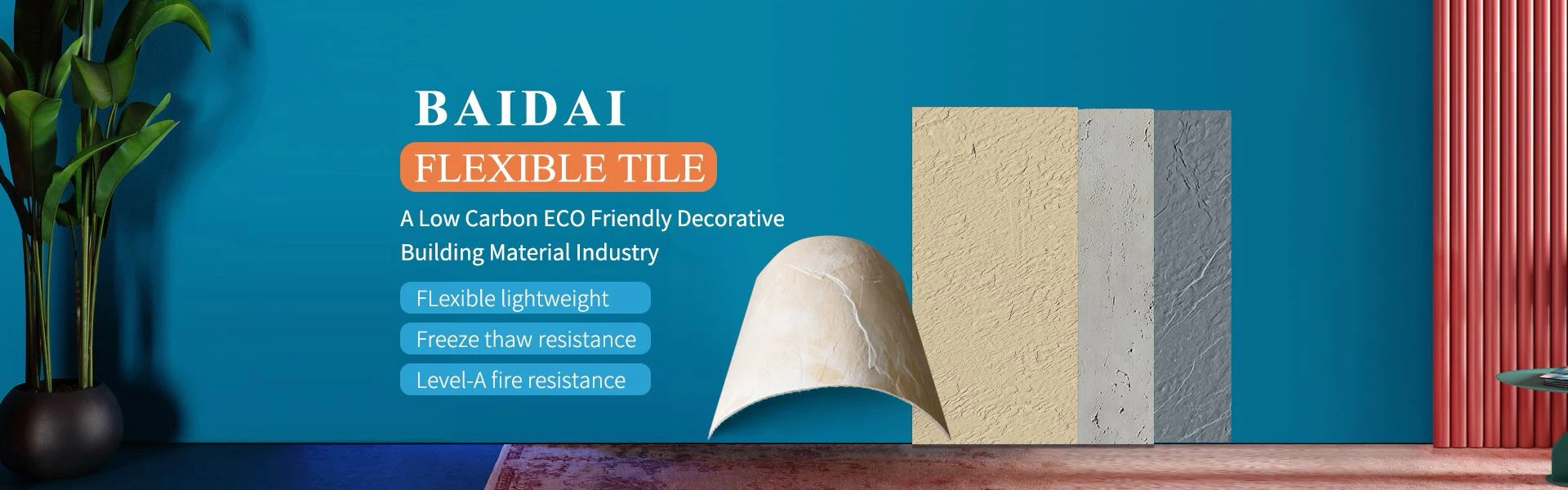
In the past two years, major decoration markets have been occupied by a new type of decoration material called soft porcelain. Many consumers and owners find it particularly fresh. A majority of customers have already started to install and use, and another part of customers are still waiting and investigating. What is soft porcelain? Where are the advantages? Where is it suitable for use? What is the difference with traditional decoration materials? What should we pay attention to when choosing soft tiles? The following soft porcelain manufacturers will introduce to you.
Soft porcelain is a new type of interior and exterior wall facing material that is made of inorganic materials as the main base material, coupled with high molecular polymers, and after special processing. Because its color, structure and shape can be adjusted according to user requirements, through different surface structures, the size and color of the facing bricks, the decoration materials inside and outside the building become more colorful. Soft ceramic tiles are different from traditional ceramic tiles. They contain 70% soil and 30% water-soluble additives. They are calcined at a high temperature of 400°C and finally shaped by light radiation. It is a recyclable ceramic tile, which is returned to dirt after recycling. Very good in terms of sustainable development and green decoration. Due to its technology and composition, soft ceramic tiles can save up to 80% of losses. The quality is stable, the brick body is light and thin, the transportation cost of soft ceramic tiles is also low, and the price is very affordable.
The biggest advantage of soft porcelain over traditional tiles is its toughness. Tiles give us the feeling of being cold, fragile, hard, and distant. The soft porcelain is not only flexible and can be bent, but also soft and thin, increasing the warm feeling of space. Compared with wooden floors, various wall panels, wallpaper and other decorative materials, our soft porcelain also has fire-retardant functions. It is suitable for school exterior walls, hospital exterior walls, residential exterior walls, etc. The biggest advantage is safety. Because the material itself is relatively light and thin, the thickness is only about 3MM, and the weight is 1/25 of the tile. Falling from high altitude is not easy to hurt people.
Soft porcelain has a variety of shapes and colors, and is flexible and easy to shape. It has a wide range of safe and environmentally friendly paving. It is no exaggeration to say that as long as you can give flat soft porcelain, you can paste it, and even customize it according to the customer's decoration style. How can such a new material not be loved by the public?
soft porcelain also has a greater advantage in pasting than traditional hard tiles. Traditional hard ceramic tiles are very heavy and difficult to paste. When cutting, it is necessary to use an angle grinder to connect to the electricity and then cut, and it will cause dust to pollute the environment and damage the body of the person who pastes it. The cutting of soft porcelain only needs to mark out the traces with a wallpaper knife, and it can be neatly broken with a light break. It can be pasted regardless of whether it has electricity or not, which greatly saves time and cost. Due to its flexibility, there is almost no damage during construction or logistics transportation, which saves resources.
In addition, the soft porcelain also has the function of moisture-proof and anti-skid. If there are elderly and children in the house, it is recommended that the floor be covered with soft porcelain. There are many types of soft porcelain, such as imitation stone, imitation metal, imitation carving, imitation weaving and imitation wood grain, imitation leather grain series and so on. In addition, some styles have clear lines and fine carvings, which almost achieve a fake effect. Choosing soft tiles will not only bring more decoration to the home, but also give designers more creative space. With such a caring and practical product, would you still choose traditional hard ceramic tiles for decoration?