
Three points of materials and seven points of labor, especially for new materials, unfamiliar workers, improper operations, and unqualified construction levels may cause quality problems. Therefore, the soft porcelain manufacturers have compiled the following 11 points for attention for your reference.
1. Correctly understand the characteristics of soft porcelain
Soft porcelain products are different from paints and exterior wall tiles. They are new materials. They are different from traditional materials in terms of appearance, color difference, and application. Therefore, the construction team must have a correct understanding of the product.
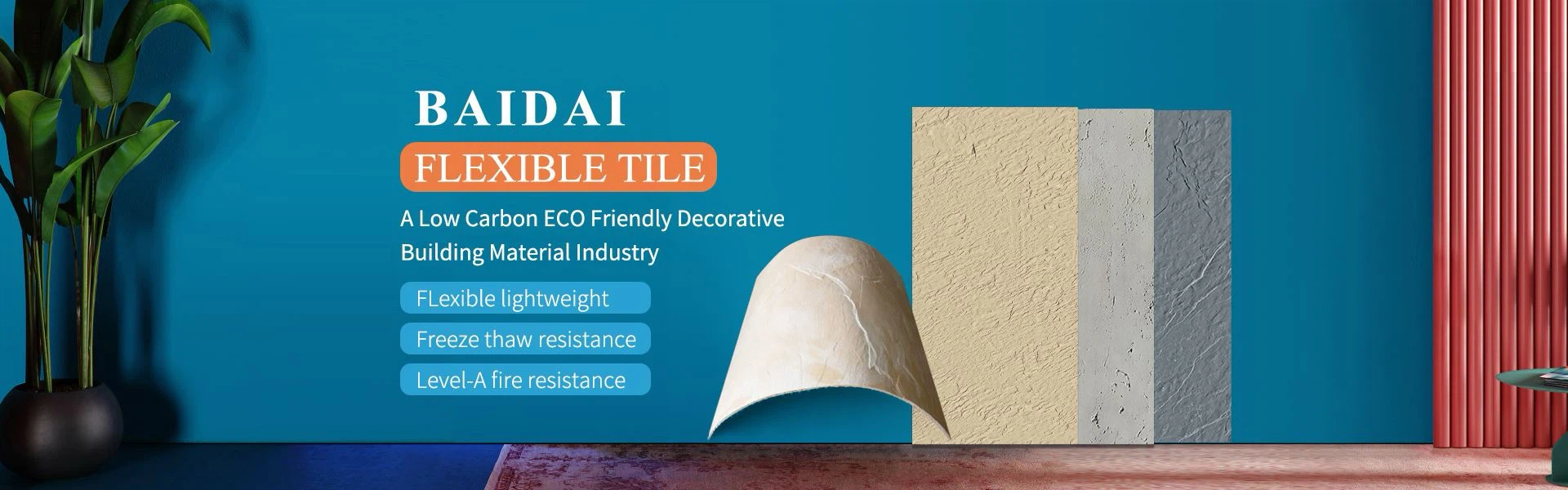
Light: average weight: 3~6kg/㎡, reducing load
Thin: Average thickness: 3~5mm (except art products)
Flexible: flexible, shockproof and crack resistant
2. Grassroots treatment is very important
The basic treatment of walls and ground is very important. Before paving, the basic level must be cleaned to ensure that it is level. All kinds of dirt, plastering, oil, chalking, hollowing, etc. must be treated well. Soft porcelain requires certain requirements for the basic level. It is flat. Whether it is a new wall or an old base, it must be ensured that there is basically no chalking, cracking, bumps, or hollowing.
3. Special adhesive
There is a wide variety of exterior wall bonding materials on the market, but they are uneven. You must not use non-standard adhesives for cheap. In order to ensure the firmness of the bond and the durability of use, the soft porcelain paste material must be matched with a special MCM adhesive to ensure the safety, firmness and non-alkali of the external wall. Two-component adhesive for soft porcelain, including component A, emulsion B and quartz sand. Among them, the quartz sand must be 80-100 mesh, with a silicon content of more than 90%.
4. Make a small area to paste the sample
Before large-area paving and use, a small-area sample should be pasted on the original wall surface, and the product style and fastness of the pasting should be confirmed, and then large-area pasting.
5. Pay attention to batches and retention
Pay attention to the production batch and color number. Before paving, pay attention to the application principles of different batches and different walls. In addition, when encountering scaffolds, air-conditioning holes, etc., the same batch of products must be reserved in advance, and the same batch of products will be added in the final stage.
6. Pay attention to seam and joint treatment
According to different types of soft porcelain products, there are three ways to leave seams. One is 1mm natural seam, which can be sewn with blades of the same thickness to make seams uniform and coordinated. The second is the jointing, which should be dented and rounded and saturated. Remember, after squeezing the caulking agent, do not immediately joint joints. When it is half dry, use round steel bars to joint the joints. If the jointing agent overflows outside the joints, do not wipe it wet. When it is half dry, shovel it away. Third, the decorative seams can be made with the standard decorative seams of soft porcelain manufacturers, and the effect is better when used in interior.
7. Treatment of external and internal corners
Corner processing is very important, and the corner position best reflects the details of a project. The corners of soft porcelain must be pasted with paste. Generally, begonia angle and 45° chamfering are used.
8. Scraper behind
The fullness of the back of the product must be above 90%. 1-3mm space can be left on the four sides without squeegee, which is convenient to hold, so as not to stain hands and corners. Scrape a layer of adhesive evenly and thinly on the back of the soft porcelain. The slurry must be scraped with a serrated trowel. The thickness of the slurry is 1-2mm. The scraping surface must be uniform. Do not stick or scrape thick slurry. After scraping the slurry, check that the sides of the soft porcelain and the hands are not contaminated by adhesives and others before sticking.
9. Paste and compact with rubber sheet
Because soft porcelain is a flexible material, the compaction method is different from that of ceramic tiles. It cannot be knocked with a rubber hammer, but should be beaten with a rubber plate to make the contact even. Not to press with your fingers.
10. Surface protection
During the pasting process, the adhesive must be prevented from staining the surface of the product. In case of contamination, it must not be wiped with hands or wet towels. Only use a dry sponge and a small spatula to clean after semi-dry; when working with paint, real stone paint, etc., mainly protect the surface of the product and not be contaminated by the paint. It is best to brush the paint first, and then wait for other operations to be completed. Then paste soft porcelain products.
11. Weather
For soft porcelain exterior wall work, the suitable environment temperature for construction is between 10℃-40℃. When the operating environment temperature cannot meet the requirements, corresponding measures should be taken. In addition, the operating environment humidity should be ≤80%. Attention should be paid to weather information, and rain and exposure should be avoided during outdoor construction.